1. If government and central bank dish out freshly created money to households and/or firms in trouble, that will result (all else equal) in a bloated stock of base money (aka “government debt”) in a year or so’s time, which will have to be reined in via tax increases, and/or interest rates will have to be artificially raised. (As MMT has explained, base money and government debt are pretty much the same thing.)
2. It’s possible the latter new money could stoke inflation BEFORE the year is out, though given the lack of anything to spend money on because so many retail outlets have closed and airlines are grounded, it’s a doubtful that new money will stoke inflation in the next year or so.
3. Rather than go for the latter sudden rise in taxes and/or interest rates in a year’s time, it’s preferable, as far as possible, to raise taxes NOW. In effect that means the better off pay for the expanded unemployment benefit bill NOW.
4. Also, and again, so as to avoid the latter spike in taxes and/or interest rates in a year’s time, it is desirable to minimise the above handouts in as far as that’s compatible with everyone having at least the basic essentials. I.e. handouts for firms are not a good idea because the free market has perfectly good solutions for that problem: basically debtor firms go bust and get taken over by those with cash to spare, and/or creditors do a bit of debt forgiveness and/or grant longer periods over which to repay debts.
Summary. Much of Selgin & White’s work “In Defense of Fiduciary Media…”, published in 2005, is a thoughtful consideration of the much disputed question as to whether our existing or “fractional reserve” bank system is fraudulent. One argument they put against the fraud charge is that fraud only takes place where someone loses money for unacceptable reasons. Actually there is such a thing as a fraudulent offer: that is, it is possible a system or organisation to be fraudulent because of the fraudulent offers it makes, even if no one actually loses money.
Selgion and White (henceforth "the authors") also argue against full reserve banking, as they usually do. However, it is argued below that full reserve is actually compatible with Selgin & White’s views.
____________
The basic “fraud accusation” made against fractional reserve is as follows. Fractional reserve banks accept depositors’ money and lend on that money, but then claim depositors’ money is totally safe. That is, banks promise depositors that assuming a depositor does not ask a bank to transfer some of the depositor’s money to a third party, the depositor will get $X back from the bank for every $X deposited (possibly plus interest and possibly less bank charges). But that promise is clearly fraudulent because much of that money is loaned on by the bank, and loaned out money is never totally safe. Indeed, any promise of that nature is classed as fraud when done by financial institutions other than banks (e.g. pension funds, mutual funds, unit trusts etc). Ergo the reality is that it is fraud when done by a bank: it is only legal because governments have given banks an entirely artificial form of privilege, namely excusing them from the “fraud charge”.
Incidentally and re the idea that banks are not intermediaries, but rather entities which create the money they lend from thin air, I deal with that point here. Plus a Bank of England article makes much the same points in that connection that I do: the point being that while commercial banks do create money, they also act as intermediaries. (Title of the two latter works are respectively, "Our bank system is fraudulent and risky" and "Money Creation in the Modern Economy")
Fraudulent offers.
One debatable claim by the authors, is as follows.
In the first para under the heading “Rebutting the charge of fraud” (p.86), the authors invoke a definition of fraud which does not stand inspection. The definition is “failure to fulfil a voluntarily agreed upon transfer of property”.
Well I suggest that whether or not a failure to transfer property takes place or not has no bearing on whether the offer made by banks to depositors is fraudulent or not.
To illustrate, if I offer to take money off you and put the money on a horse and I tell you you’re guaranteed to win money or at least get your money back, that is a fraudulent offer, and for the obvious reason that any horse can perform badly on a particular day! Whether you actually give me money, and whether you actually do or don’t get your money back has no bearing on whether the original offer was fraudulent.
Indeed, I consulted a lawyer friend of mine on this, and he confirmed that the common sense view here correct: that is, a dishonest or fraudulent offer is itself fraud regardless of whether anyone loses money as a result of the offer.
Fractional and 100 percent reserve accounts.
Then in the next paragraph, the authors argue that banks only act in a fraudulent way if they claim to operate 100 percent reserve accounts when in fact they are operating fractional reserve accounts. As they put it, “…it is fraudulent for a bank to hold fractional reserves if and only if the bank misrepresents itself as holding 100 percent reserves, or if the contract expressly calls for the holding of 100 percent reserves.' If a bank does not represent or expressly oblige itself to hold 100 percent reserves, then fractional reserves do not violate the contractual agreement between the bank and its customer…”. (The authors make much the same point near the bottom of their p.88).
Well the simple answer to that is that about 90% of depositors don’t have any idea what the phrases “100 percent reserve” or “fractional reserve” mean! Thus the authors’ “100 percent / fractional reserve” point is plain irrelevant.
The reality is that most depositors are persuaded by banks that depositors’ money is totally safe, and the second undeniable reality is that that money just isn't totally safe: witness the fact that taxpayers had to come to the rescue of sundry banks during the bank crisis that started in 2007/8!
I.e. fractional reserve is only safe because governments back the fraud / risky practice that is fractional reserve with near limitless amounts of taxpayers’ money.
Interference with free markets.
Next, in the para starting “But whether the informed…” (p.88), the authors argue that a ban on fractional reserve would amount to an unjustified interference with the right of banks and depositors to come to mutually acceptable agreements.
That’s a good point: i.e. it is hard to see why depositors should not have fractional reserve accounts, as long as relevant banks make it abundantly clear that depositors’ money can go up in smoke any time. After all, people are free to place their money with mutual funds, private pension schemes etc and the latter sort of entities have to make it very clear that depositor / investors can lose as well as make money in the process.
Indeed, the authors say “The remaining normative debate boils down to the question of whether a warning sticker really is needed to avoid misleading customers . . . . . and, if so, to the question of how explicit the sticker must be.”
Well the authors do not answer the latter question, but never mind: I have an answer. The answer is that if banks offering fractional reserve accounts had to publish the the sort of “health warning” or “sticker” that mutual funds etc are required to publish and with equal frequency, then banks would be competing on a level playing field with respect to those other financial institutions. In other words that “level playing field” requirement would dispose of the current reality, namely that banks are artificially privileged in that they DO NOT need to make it clear that depositors that risks are involved in fractional reserve banking.
But we have now arrived at full reserve banking!
Astute readers will by now have realised that we have arrived, ironically, at the sort of set up advocated by proponents of full reserve banking, e.g. Positive Money and Lawrence Kotlikoff. That’s a set up where depositors have a choice of two types of account: first, totally safe accounts, where money is simply held in a totally safe manner and not loaned on and thus little or no interest is earned. Second, there are risky accounts (“investment accounts” as Positive Money calls them) where interest is earned. (Title of Kotlikoff's work: "The Economic Consequences of the Vickers Commission")
The only element that might seem to be missing from the set up we have arrived at is the latter “totally safe” accounts. Well actually totally safe accounts are in fact available!
As the authors make clear, full reserve accounts are already available in that people can store central bank notes (e.g. $100 bills) in safe deposit boxes (top of p.97).
Safe deposit boxes are relatively expensive, thus they are not an option for many people. However several governments operate state run savings banks where depositors’ money is invested just in government debt (“National Savings and Investments” in the UK).
That is clearly a much cheaper way of organising totally safe accounts, and indeed in the case of UK’s NSI, far from depositors necessarily being charged for holding such accounts, they actually get interest (depending on the type of account).
And as for countries which do not have state run savings banks, those who want their money to be stored in a totally safe way can always buy government debt, with short term debt being more appropriate here than long term debt, though of course that’s not an option for small savers.
Of course the latter interest paid by NSI rather clashes with the above mentioned “little or no interest” that people with safe accounts are supposed to get. Well the answer to that is that if government choses to pay interest to those depositing money with government, then more fool government: personally I agree with the idea backed by many advocates of Modern Monetary Theory (and Milton Friedman) namely that governments should normally pay no interest on money deposited with government.
To summarise, it seems that while the authors have criticised full reserve banking in numerous publications, their views are actually very much compatible with full reserve – bar one remaining problem, as follows.
Banning private money creation.
Most advocates of full reserve want to ban money creation by private / commercial banks. So does the above “set up” result in such a ban?
Well not in the sense that under the above set up people would be free to buy as much “fractional reserve money” as they wanted. But that money is not as genuine a form of money as base money in that fractional reserve money can suddenly lose value, if it turns out the issuer of the money has made silly loans. Thus that so-called money is not really money.
Another way in which organisations offering fractional reserve money might seem to be free to issue as much of the stuff as they wanted, in the way they can under the existing system, is for them to simply issue home made money to any borrower who looks viable.
However, there is a problem there for those “issuers” as followers. A proportion of the recipients of that new money will inevitably want their money to be in the above mentioned totally safe form: i.e. to take the form of base money. But it’s the central bank which determines the total stock of base money. Thus any of the above issuers which issue an excessive amount of home made money would find themselves short of base money (aka “reserves”). And possibly Selgin and White might not be too happy about that.
However, I suggest S&W need to bear in mind that central banks actually restrict the amount of home made money that commercial banks issue even under the existing system. To illustrate, if there’s an outbreak of Alan Greenspan’s “irrational exuberance”, and commercial banks create and lend out freshly minted home made money like there’s no tomorrow, the result will be an excessive rise in demand, as a result of which the central bank is likely to raise interest rates so as to rein in the amount of money that commercial banks create and lend out.
Conclusion.
Assuming those who want fractional reserve accounts are warned of the dangers in the same way as those who buy into mutual funds or private pension schemes are warned, then given that most countries already have totally safe accounts like those offered by the UK’s National Savings and Investments, the resulting set up would amount to the sort of full reserve system advocated by Positive Money, Lawrence Kotlikoff and others. And that system is not as incompatible with the views of Selgin and White as perhaps Selgin and White think.

I dealt with about forty mistakes made by supporters of the existing bank system here. But the blunders just keep coming.
A new one I just stumbled across was made by Tim Worstall (who I actually agree with much of the time). He claims in this article that fractional reserve banking is indeed fraudulent, but that it’s what he calls a “useful fraud”. (Title of his article: “There’s An Obvious Answer To Fractional Reserve Banking…”)
His first claim is that fractional reserve gives us so called “maturity transformation”, which indeed it does: that is, and to put it in plain English, it makes various assets more liquid, i.e. more like money.
Well the answer to that is that if maturity transformation (i.e. fractional reserve) was abolished, the initial effect would, as TW implies, be deflationary (in the sense of reducing demand). But that problem is of course easily dealt with by having government and central bank create and spend more money into the economy.
Moreover, government and central bank do not need to engage in any sort of fraud to do that.
Plus, government / central bank created money does not run any sort of risk of bank failures. As Messers Douglas and Rajan put it in the abstract of this paper of theirs, in order for banks to perform their basic function under the existing system, they have to have “a fragile capital structure, subject to bank runs…” – which is hardly glowing praise for the existing system. (Title of their paper: "Liquidity risk, liquidity creation and financial fragility....")
In view of the latter point, I’d describe the existing system as “raving bonkers”, but perhaps other words would be more appropriate.
Funding thirty year mortgages.
Second, TW makes the absurd claim that under full reserve (the alternative to fractional reserve) depositors would have to deposit money for thirty years if people are to be able to get thirty year mortgages.
Well that’s not consistent with the fact that a fair amount of industrial investment is funded via shares, i.e. equity, and shareholders can sell out any time, but the investments they fund can easily last thirty years, and sometimes longer.
Of course the latter bit of magic relies on not too many shareholders all wanting to sell out at once. But about 99% of the time, there is no mad rush for the exit, or put another way, the number of potential shareholders wanting in is normally matched approximately by the number wanting out.
Indeed had TW actually studied the works of those who promote full reserve, in particular Positive Money and Lawrence Kotlikoff, he’d have discovered that under full reserve, mortgages are funded in much the same way as the latter industrial investments. Thus TW’s “30 year” criticism is not valid.
I’m a pensioner and have medical problems apart from age, so I’m a sitting duck for Corona. The UK government is proving free food handouts for people like me to save us going to shops and risking infection there. The first batch arrived today. I’m impressed, given the speed with which this was done.
The “week’s supply” consists of 4kg potatoes, 2kg carrots, 0.5kg cooked rice, 1kg Rice Krispies, 1 tin corned beef, 5 apples, 5 tangerines, 1kg spagetti. 10 tea bags, 10 sachets instant coffee, half a liter of milk, 10 biscits, 850 kg peas, 850 kg fruit cocktail, 200 g tinned tuna, soap, 850kg tomato sauce, 1 loaf bread, 4 400g tins tomatoe soup and 2 400g tins baked beans.
A few items obviously missing there: e.g. vitamin C, jam, margarine or butter, but perhaps they’ll come next week.
Official advice, e.g. from the World Health Organisation, is that face masks are a waste of time.
I’m not surprised: why would a virus be stopped just because it has to pass thru a bit of fabric? Obviously it might land on the fabric, but that won’t do it any harm, plus it might get dislodged and travel onwards into your mouth next time you breath in.
Morover, I suspect the seal around the edge of those masks you see people wearing is not too good.
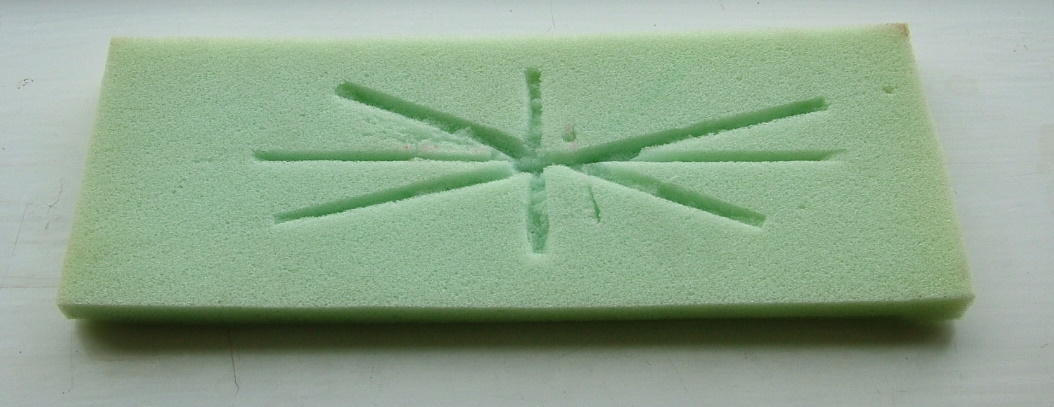
In contrast, if the mask is soaked in soapy water, that will tend to kill Corona virus. Hence my home made enhanced mask pictured above which I’ll wear next time I have to go to a shop for groceries.
It’s made of 10mm thick foam rubber. If pulled tightly over the mouth, that ought to form a good seal round the edges.
Soaking it in soapy water obviously increases the resistance to air passing thru the foam rubber. If the rubber is completely saturated, the resistance is far too much. But the degree of resistance is easily controlled by squeezing some or most of the water out before putting it on.
Obviously it would tend to dry out and thus become useless after a while, but the actual degree of drying when I’ve worn it in a centrally heated room for five minutes seems to be negligible according to the moisture detector device pictured below. Plus anyone wanting to wear something like this for an extended period could easily carry a hand held device for spraying water on the mask from time to time to keep it moist.

The set up in the picture protects the mouth, but not the nose, so I need to take care to breath in only thru my mouth while in the shop. A “mouth and nose” protecting model ought to be feasible.
Clearly it’s desirable to maximise the AREA of foam rubber thru which air has to pass. That’s what the grooves in the rubber are for. The “groove side” of the mask faces my mouth, while the other side is not grooved and faces the outside world. The grooves help draw air in from AROUND the mouth rather than just the area of an open mouth: roughly 40mm x 30mm.
I’ll wear a standard white face mask over this contraption so as not to look too eccentric!
If you want to try this, it’s entirely at your own risk. I have no medical qualifications or other relevant qualifications in this area. This “soapy water mask” idea is certainly not guaranteed to give you total protection, but it might improve your chances. Plus soap (and similar substances like washing up liquid) give off various odours and chemicals and I have no idea what undesirable side effects might arise from breathing those in for an extended period.
If any undesirable side effects seem to arise from this idea, or if I come across any suggestions that there might be such side effects, I’ll put a note to that effect right here as soon as I can.
Stop press (4pm 31st Mar 2020). Latest enhancement: two foam rubber plugs to go up my nose. Soaking them in soapy water, squeezing out most of the water and leaving them up my nose for 5 minutes does not seem to irritate my nose - if you're interested....:-)
.
Stop press (1st April). There's a guide as to the best materials for DIY masks at this site.
The stock response to any problem from the political left, is for “government to do something”, and the problems for corporations due to the Corona outbreak has elicited the above knee jerk response from Eric Lonergan and Mark Blyth in this IPPR publication, and from Ann Pettifor here.
Titles of the two works are respectively "Beyond Bailouts" and "The Macroeconomic Imperative of Nationalisation."
The first weakness in the above two publications is that none of the authors are aware of the perfectly workable free market response to the current crisis. To argue that a government lead response would be better than the free market’s is one thing, but to be totally unaware of the free market’s response indicates incompetence. So seems I better explain the free market’s response, which is thus.
One solution is for firms in difficulties to simply refuse to pay creditors, and then go along to creditors and politely inform them that creditors can of course push debtors into bankruptcy, but it’s very debatable as to whether that’s creditor’s best option, particularly given that debtor firms will in most cases be good bets in the long run.
Put another way, if creditors do push debtors into bankruptcy, are they really going to get all that many pence in the pound compared to what they’ll get if they allow debtors a period of grace?
And what do you know? Banks are actually adopting the latter common sense approach!
Plus the UK pub chain Weatherspoons has actually adopted the latter “tell creditors to get stuffed” strategy.
Plus the above sentiments of mine seem to be supported by David Andolfatto of the St Louis Fed in a Twitter thread on 25th March.
Moreover, even if creditors do push a corporation into bankruptcy, those corporations do not cease to exist, as seems to be implied by the above three authors. What happens is that, assuming relevant businesses look like being viable in the long term, then someone will make a bid for the business (at a knock-down or bargain basement price of course). Existing shareholders and bond holders are wiped out. Then when things recover, the new owners find themselves in possession of a valuable business for which they paid a bargain basement price.
Hey presto: those with cash to spare (Warren Buffet or whoever) make themselves a few million or billion! Problem solved.
Of course the workload on bankruptcy lawyers and accountants will be horrendous, thus the PACE at which bankruptcy can be organised will be much slower than usual. But the idea that government led rescues would be the solution to that problem is just pie in the sky: governments have enough to do just at the moment. Plus where does government get those who are skilled at valuing the assets of firms in trouble? Those skilled people are already fully employed trying to weigh the pros and cons of bankruptcies!
The virus can allegedly enter your body via the eyes, though there seems to be some debate about this. Anyway, as a cheap precaution, if you’re forced to go to work on a crowded bus or train, wear one of these cheap eye protectors obtainable from most builders merchants, DIY stores or Screwfix. They cost next to nothing: between £2 and £10.
Not guaranteed to keep you safe of course, but they might reduce the chance of being infected.
A much more expensive and possibly better form of protection: one of these full face protectors with a battery powered air supply: £269 from Screwfix. Obviously you’d need to rig up some way of filtering the air thru some sort of cloth soaked in soapy water. Viruses would tend to get caught and killed by the soapy water.
Plus there’s the problem that the cloth would dry out fairly quickly, which would render it useless. So you’d need a fairly large volume of filter to slow down the rate of drying, or some sort of replaceable cartridge containing fresh and damp filtering clot. Solving those two problems would a DIY enthusiast’s idea of heaven.!
Plus there are a variety of other face or "mouth and nose" masks with replaceable filters available from Screwfix. It might be possible to do the "soapy water" trick with those. Though note that soaking a filter with soapy water increases the resistance to air flowing thru the filter, so you'd probably need some sort of DIY way of artificially increasing the size / diameter of the filters.
Please note: I have no qualifications whatever in medicine. If you try any of the above ideas, that’s entirely at your own risk. Plus DIY adjustments to face masks etc would obviously invalidate the manufacturer's warrenty.