Godfrey Bloom, former UK Independence Party Member of the European Parliament, exhorts us to read his allegedly insightful book on banking in the tweet below.
Godfrey Bloom also has a habit of assuring us that he is “always right” or words to that effect. So clearly we all have much to learn from him (ho ho). E.g.:
Anyway, I thought I’d have a look at his book which is entitled “The Magic of Banking”.
I do like Bloom’s politically incorrect views and tweets. His political nous is way superior to that of self-styled “political commentators” who write for broadsheet newspapers. However, his ideas on banks are not well thought out.
First, he is obsessed by inflation. For example on p.2 there is a chart (see below) showing a one year period during the worst of the German inflation in the early 1920s. (Actually p.2 is part of the foreword and is written by someone else, but that chart couldn’t possibly have been inserted without Bloom’s approval).

Now that’s a bit like having a picture of the Titanic sinking at the start of a book on ships designed to persuade readers that ships are not safe. I shouldn’t need to point this out, but shipbuilders, ship owners, etc are well aware of the dangers of crashing ships into rocks, icebergs and so on. That’s why they spend large amounts on navigation aids, and on training ship captains, navigators etc. It is also why rocks are marked by buoys and so on (gasps of amazement).
Likewise in the case in banks and economics generally, we’re all aware of the dangers of excessive inflation. That’s why most governments have an inflation target of around 2% (more gasps of amazement).
Basic maths.
Bloom also seems to have a problem with basic maths. That is, on p.14 there is another chart showing the exponential increase in the money supply between 1960 and 2010 with the heading “How can this continue?” Well the answer is that given ANY level of continuous year after year inflation (2% or whatever) there will be an exponential increase in the money supply and an exponential fall in the value of money.
As to how that can continue, the answer is “very easily”. As Bloom rightly points out, dollars are now worth a less than tenth of what they were worth before WWI. But what of it? We just have very roughly ten times more dollars, and dollars continue to perform the function they have always performed, namely obviating the inefficiency of barter.
A hundred years from now, dollars will be worth a tenth or less of what they are worth now, but what of it? The problem eludes me.
Certainly money is no use as a form of LONG TERM saving. But that’s not its main function. Its main function is to avoid the inefficiencies of barter, which it does very well.
Apart from the above flawed points on inflation, Bloom’s work is not too bad up to p.17, but then serious mistakes appear on that page. He claims that bank bailouts at the height of the recent crisis cost taxpayers “trillions”. As he puts it:
“Trillions of dollars, pounds and Euro’s just put on account for future generations to somehow pay off. Such is the enormity of the debts and the cost of servicing them that it is inconceivable they can be repaid.”
Well first, the “trillions” figure is a mile out. EXACT figures for the bailout are hard to come by, and presumably because the revolving door brigade wants to obfuscate and muddy the whole question as to exactly what the bail out cost. However, far as I can see, the maximum amount the Fed loaned out at any one time was around one trillion dollars, while the AVERAGE amount loaned out over the 18 months of the worst of the crisis was around $600bn. That’s according to the chart in an article by Mick West entitled “Debunked: The Fed “gave away” $16 trillion…”
Moreover, all of that one trillion was paid back, so in that sense there was no cost for the taxpayer. However, there WAS a cost for the country as a whole in that there was a gross mis-allocation of resources. That is, instead of lending money to private banks at Walter Bagehot’s famous “penalty rate”, the actual rate was near zero. I.e. the loans were sweetheart loans.
The normal rule in free markets is that resources go to whoever bids the most for them. And a bunch of corporations who bid nothing for loads of lovely money are pretty obviously not the most commercially viable corporations or borrowers in the country. I.e Main Street would have paid good money for some of that freshly printed central bank money.
That horrendous national debt.
Also on p.17, Bloom falls for the popular myth that the national debt is out of control, and we’re on the verge of bankruptcy. Bloom is clearly unaware that the debt in the UK as a proportion of GDP is nowhere near where it was just after WWII or in the middle of the 1800s.
Think I’ve had enough of this nonsense. I can’t be bothered reading any further.
Republicans spent the last eight years or so crying wolf about the deficit (pretty obviously so as to knobble Obama). Then, before the new Republican president, Trump, is even sworn in, Republicans (Trump in particular) say the deficit for some strange reason no longer matters.
Put another way, Republicans are more than happy to shaft the unemployed if that helps them in turn to shaft Democrats. And this is nowhere near the first time this blatant dishonesty in relation to the deficit has happened: regular as clockwork over the last fifty years, when Republicans come to power, the deficit (which they claim to disapprove of) goes thru the roof.
This all supports the idea put by Positive Money, the New Economics Foundation and Richard Werner that decisions on the SIZE OF the deficit should not be in the hands of politicians. I.e. decisions on the size of a stimulus package should not be in the hands of politicians.
In contrast, it’s fair enough for obviously political decisions, like what % of GDP is allocated to public spending to remain with politicians.
It’s normal practice for the brainless lefties who write for the Guardian to accuse those who want less immigration of hating foreigners (xenophobia). Indeed, that accusation has appeared in The Guardian (and indeed other supposedly “intelligent” broadsheet newspapers) about a thousand times, without so much as the beginnings of an attempt to substantiate the accusation.
In fact the accusation is VERY DIFFICULT to prove since it has hard to prove MOTIVE, though the latter point will be way beyond the comprehension of the aforesaid brainless lefties. How do you prove someone wants less immigration because (1) they hate or fear foreigners rather than (2) because they want to preserve their country’s traditions, way of life, identity, etc? It’s near impossible!
Moreover, the idea that for example members of the UKIP hate foreigners is a bit hard to square with the fact that UKIP members go abroad for their holidays like every one else, and mix with those ghastly foreigners.
And what’s that Nigel Farage doing making friends with Donald Trump? Doesn’t Nigel Farage realize Trump is a foreigner…:-) The Guardian really needs to fill us in on that one.
And one more nail in the “nasty leftie” claim that opponents of immigration hate foreigners is that when Tibetans say they want to preserve their country’s culture, identity and so on, lefties go all dewy eyed. But that’s just the millionth example of lefties having one set of rules for people with white skin and a different set for those with brown skin. And unless you’re as dim as a Guardian journalist, you’ll have noticed that that preferential treatment for brown skinned people is a form of racism.
Anyway…academics. I’ve just discovered that a group of academic economists were into this dimwit “hate foreigners” nonsense in the run up to the Brexit vote. That’s in an article entitled “Immigration brings both benefits and costs…” published by “Critical Macro Finance”. The article starts:
“If UK voters decide to leave the European Union, it will be for one reason above all. From the outset, nationalism bordering on xenophobia…”.
Of course to be strictly accurate, the authors don’t actually accuse anyone of xenophobia: they accuse them of “nationalism bordering on xenophobia”. But that’s just weasel words, far as I’m concerned. Moreover, the authors accuse Brexiteers of being motivated PRIMARILY by “nationalism bordering on xenophobia”. Thus the authors are clearly pulling out every stop to give the impression that Brexiteers hate or fear foreigners without actually saying so.
Don’t think I’ll bother to acquaint myself with any more of the amazing insights published by “Critical Macro Finance”
I last commented on this idea around two months ago here.
But just recently another article has appeared on this subject, entitled “Steve Keen: rebel economist with a cause” published by ‘Financial Review’.
This latest article contains a LITTLE extra information on the all important DETAILS on how this jubilee will work. The information is not nearly enough, but I’ll comment on it anyway.
To recap, Keen’s basic idea is that government prints loads of money and gives it to debtors on condition they use it to pay down their debts. But Keen recognises that that involves a big windfall for debtors and nothing for creditors. So he proposes putting that right by printing even more money and giving that to creditors.
There is of course a glaring flaw in all this, namely that (to put it figuratively) simply printing tons of $100 bills and giving them to everyone is inflationary (assuming the economy is already at capacity). I’ll come back to that point later.
But as already intimated, the Financial Review article does at least contain a few more details on how this debt jubilee might work. To quote:
“Keen believes there needs to be a reset of private debt levels via a "people's quantitative easing" – effectively, a government bailout of households – to something more in the order of 50-100 per cent of GDP, from around 120 per cent now.”
So now it seems that Keen is contemplating a more modest jubilee. For example, on the basis of the latter percentages, debt as a percentage of GDP might decline from an existing 120% to 100%. That’s far more modest than wiping out all mortgages, as originally proposed. However, that doesn’t actually stop the whole idea being nonsense, and for the following reasons.
Suppose half the country are debtors (mortgagors) and half are creditors. Also assume the aim is to cut the debt of the average debtor by $X. Also assume the economy is already at capacity.
So….government prints $X per debtor and dishes $X out to each debtor, who in turn passes the money on to a creditor. Plus government prints yet more money and gives $X to each creditor.
The end result is that both debtors’ and creditors’s net assets rise by $X, so they’ll go on a spending spree! Enter hyperinflation, stage left. What to do?
Well government can of course nullify the latter “inflationary effect stemming from increased household net assets” by increasing taxes on every household to the tune of $X.
But wait a moment…..that puts us back where we started! The whole exercise is a farce!
Better bank regulation.
In the Financial Review article, Keen also advocates tighter bank regulation, e.g. in the form of limiting loans to some multiple of the rental value of a property. That would be an ALTERNATIVE to a jubilee, presumably.
Well my first problem with that is that bank lending in Keen’s native Australia (the country he is primarily concerned with) is already fairly tightly regulated compared to elsewhere (though admittedly I’m not the world’s expert on that).
Second, there is a much simpler solution, which is to abolish fractional reserve banking and replace it with full reserve. Under the latter, anyone making a silly loan bears the full cost of any disaster that ensues, rather than taxpayers bearing the cost. I.e. under full reserve, there is no need to regulate lenders at all (which regulation is arguably pretty ineffective anyway). That is, lenders can do what they want, just like people can by whichever shares they want on the stock market. If those shares turn out to be worthless, there is no taxpayer funded rescue, and quite right. Same should apply to people who make silly loans.
The latter is a very simplified descripton of how full reserve would work. But I’ve set out more detailed descriptions elsewhere.
Of course that still leaves a problem to which Keen rightly alludes, namely that given a collapse in house prices and lending, there is a big deflationary effect. But the latter problem is easily dealt with via standard stimulatory measures (e.g. interest rate cuts, government budget deficits, etc).
Having spent about ten years, a lot of time and money pushing the case for full reserve, I’m pleased to see the above book, which was the Financial Times economics book of the year in 2013, also supports the idea.
However, arguing the case for full reserve is not the central objective of the book: as the title implies, the book is a history of money, and it goes right back to the beginning. I.e. it covers ancient Mesopotomia, ancient China, Greece, Rome, etc. It then moves on to Europe in the Middle Ages and on up to the present day.
It’s only near the end that the author, having considered the numerous problems associated with money, concludes that the best system is full reserve – quoting in particular (far as I remember) Milton Friedman, Irving Fisher and Lawrence Kotlikoff.
The book is brilliant: it combines readability with scholarship. For example there are about 200 items in the bibliography / references section. The book (at about 120,000 words) is also (at a guess) a bit longer than the average book.
Ancient Rome’s credit crunch.
If you want a taste of the author’s style before buying, here is a short passage describing Rome’s credit crunch.
“In such an extensively monetised economy, it is hardly surprising that the Romans were also well acquainted with another familiar feature of modern finance: the credit crisis. Occasionally, the simi¬larities with the modern age are nothing short of eerie. In AD 33, the Emperor Tiberius' financial officials were persuaded that the recent boom in private lending had become excessive. It was decided that regulation must be tightened in order to extinguish this irrational exuberance. After a brief review of the statutes, it was dis· covered that none other than the father of the dynasty, Julius Caesar, had in his wisdom instituted a law many decades before specifying strict limits on how much of their patrimony wealthy aristocrats could farm out in loans. He had, in other words, introduced a rigorous capital adequacy requirement for lenders. The law was clear enough: but not for the first time in history, industrious lenders had proved remarkably skilled at circumventing it. Their ingenious evasions, the historian Tacitus reported, 'though continually put down by new regulations, still, through strange artifices, reappeared.
Now the emperor decreed the game was up: the letter of the old dictator's law would be enforced. The consequences were chaotic. As soon as the first ruling was made, it was realised with some embarrassment that most of the Senate was in breach of it. All the familiar features of a modern banking crisis followed. There was a mad scramble to call in loans in order to comply. Seeing the danger, the authorities attempted to soften the edict by relaxing its terms and announcing a generous transitional period. But the measure came too late. The property market collapsed as mortgaged land was fire-sold to fund repayments. Mass bankruptcy threatened to engulf the financial system. With Rome in the grip of a credit crunch, the emperor was forced to implement a massive bailout. The Imperial treasury refinanced the overextended lenders with a 100-million sesterces program of three-year, interest-free loans against security of deliberately overvalued real estate. To the Senate's relief, it all ended happily: credit was thus restored, and gradually private lending resumed."
_______________
Update: This article also appears on the Seeking Alpha site.
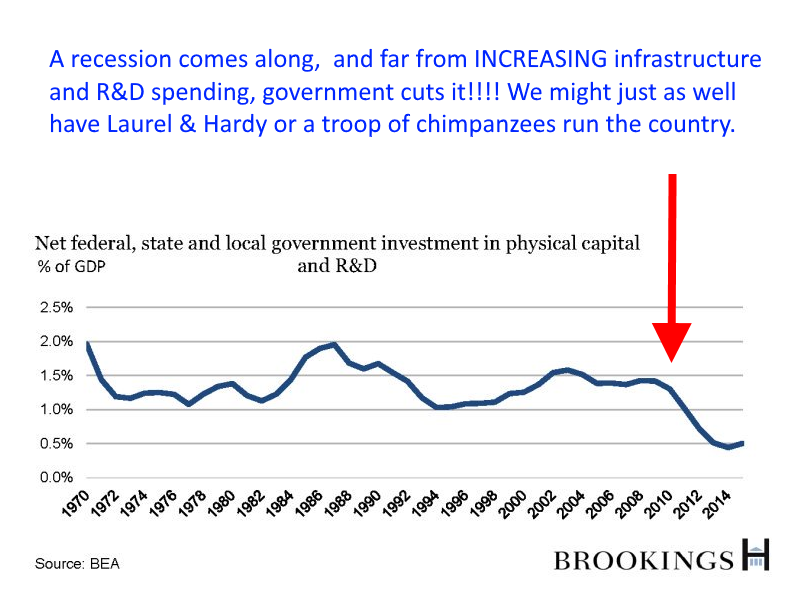
On the first chart, the red arrow and sarcastic text in blue are my own additions.
In a perfectly functioning free market and given a recession, wages and prices would fall in terms of dollars, pounds etc, which would increase the real value of the stock of money (base money in particular) which in turn would encourage spending.
In the REAL WORLD, the market is very far from perfectly free: in particular and to use Keynes's phrase, “wages are sticky downwards”. In other words, try cutting wages, and you’re likely to get strikes, if not riots.
That increase in the value of most people’s stock of money is known in economics as the “Pigou effect” after the economist Arthur Pigou.
Note that it’s the value of the stock of BASE MONEY (i.e. central bank issued money) which rises but not the value of the stock of COMMERCIAL BANK issued money that rises. At least in the case of commercial bank money, for each dollar of money there is a dollar of debt: reason is that commercial banks create or “print” money when they grant loans, as the opening sentences of a Bank of England article explains. It’s often said that commercial bank money “nets to nothing”, which is true. (The BoE article is entitled “Money creation in the modern economy”).
In other words base money is a net asset as viewed by the private sector, and by government spending departments, city authorities, etc. In contrast, commercial bank issued money is not a net asset.
In addition to the value of the stock of base money rising in a recession in a totally free market, the value of government debt also rises. Reason is that that is also a net asset as viewed by holders of that debt.
However, as MMTers (Warren Mosler in particular) pointed out some time ago, government debt is pretty much the same thing as base money. That is, the only thing government owes to holders of that debt is base money (when the debt matures). I.e. government debt can well be regarded as a deposit or term account at a bank called “government”. Martin Wolf, chief economics commentator at the Financial Times, also made that point a year or two ago. As he put it “Central-bank money can also be thought of as non-interest-bearing, irredeemable government debt. But 10-year JGBs yield less than 0.5 per cent. So the difference between the two forms of government “debt” is tiny…”. (That’s in an article entitled “Warnings from Japan for the Eurozone”).
It could perhaps be argued that if the real value of the stock of government debt rises, that might induce government to REDUCE its spending. But that would be a very irrational thing for a government to do: that would just raise unemployment. What’s the point of that?
Moreover, it is very debatable as to whether so called government debt really is a debt. Reason is that government is free to grab any amount of that “debt” (aka base money) off the private sector whenever it wants. That’s the equivalent of someone being able to walk into the bank which gave them their mortgage and grabbing wads of £10 notes so as to pay off the “debt” they owe the bank: a strange sort of debt that would be.
In short, government debt can well be regarded as an asset as viewed by holders of that debt, but not as a liability of government. As Warren Mosler put it, government debt and base money are like points in a tennis match: first they are produced from nowhere, second, they are assets as viewed by players, and third, they are not liabilities as viewed by the umpire.
Having said that the free market’s cure for a recession is a helicopter drop, that’s not quite accurate in that under a helicopter drop (pun there if you like) there is a choice as to who gets the free money. And most of us would not regard those already in possession of a pile of money as being the first priority. Nevertheless, in a helicopter drop free market style, a very WIDE RANGE of entities find themselves in possession of more spending power, (to repeat) including some central government departments, city authorities, etc.
Interest rate adjustments.
It is often assumed that the free market’s main cure for a recession is to cut interest rates. (See here for discussions as to what extent central bank interest rate adjustments are actually a REACTION to market pressures rather than the basic cause of interest rate cuts in a recession.)
No doubt interest rates do fall of their own accord in a recession, but it would not be very logical of the free market if that were the free market’s MAIN reaction to a recession: reason is that borrowing based expenditure does not account for more than a smallish proportion of total spending (in both the public and private sectors).